
Does a 7800X3D need a premium VRM? Board-by-board voltage-stage answers
The 7800X3D draws about 88 W in games and 120 W under an all-core load. That is less than a Ryzen 5 7600 in a Cinebench run, which means most of the VRM advice written for AM5 does not apply to it.
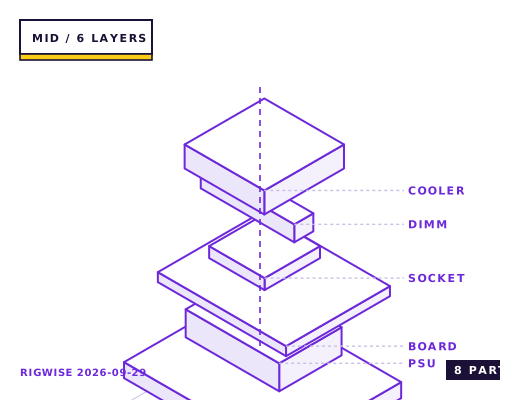
| Slot | Part | Interface | Draw | Price |
|---|---|---|---|---|
| CPU | AMD Ryzen 7 7800X3D | AM5 | 120 W | $349 |
| Motherboard | MSI MAG B650 TOMAHAWK WIFI (8+2+1 phase, BIOS Flashback) | AM5 | — | $189 |
| Memory | G.Skill Flare X5 DDR5-6000 CL30 2x16GB | DIMM | — | $104 |
| GPU | Sapphire PULSE Radeon RX 9070 16GB | PCIe 5.0 x16 | 220 W | $549 |
| Storage | WD Black SN850X 2TB NVMe | M.2 2280 | 7 W | $139 |
| Cooler | Thermalright Peerless Assassin 120 SE | AM5 | — | $36 |
| PSU | Seasonic Focus GX-750 80+ Gold | ATX | — | $109 |
| Case | Corsair 4000D Airflow | ATX | — | $89 |
| Total | 347 W | $1564 | ||
Why these parts
What the chip actually asks of the board
Measured package power for a 7800X3D: 62-88 W in games, 118-125 W under an all-core Blender render. The X3D voltage limit of 1.05-1.1 V caps current draw at roughly 115 A, which is well inside what any 8-phase VRM can deliver.
A board with six 55 A stages and no heatsink will hold this chip indefinitely. The failure stories you read about are almost all from 16-core parts on cheap boards, not from X3D chips.
What you are actually paying for above $150
Three things matter on a mid-range B650 board and none of them is the VRM: the number of M.2 slots that do not steal lanes from the graphics card, whether the board has BIOS Flashback (so you can update firmware without a CPU), and whether the memory QVL is actually maintained.
Everything else — 20 Gbps USB, Wi-Fi 7, a second 2.5 GbE port — is a convenience feature. Budget $30-60 for the ones you will use and skip the rest.
Boards to avoid with this CPU
Skip any A620 board. Not because of the VRM but because most A620 boards have no CPU overclocking, no PBO curve optimiser, and a single M.2 slot. On a 7800X3D the Curve Optimizer offset is where the free performance is, and A620 removes it.
Also check the board's M.2 lane-sharing table before buying. On several B650 boards, populating the second M.2 slot drops the x16 slot to x8, which costs 3% with a modern card and is invisible in the spec sheet.
Bottleneck note
The motherboard is never the performance bottleneck with a 7800X3D. The only ways a board costs you frames are failing to run EXPO at 6000 and dropping the graphics slot to x8.
Cooling headroom
VRM temperatures on a 6-phase board driving a 7800X3D settle at 58-64 °C in a case with any top airflow. A heatsink is nice to have but not required. The CPU cooler matters far more.
Verdict
Spend $150-190 on a B650 board with a decent M.2 layout and BIOS Flashback. Anything above that is buying features, not stability.
Tick each check once you have verified it. Ticks are stored in this browser only.
Why each check matters
Should I set SoC voltage manually or leave it on Auto?
Set it manually to 1.20-1.25 V. Auto on several boards pushes 1.30-1.40 V, which is the documented cause of the 2023 X3D degradation failures. If your board's Auto value is above 1.30 V, override it.
Is an A620 board fine if I never overclock?
Functionally yes, but you lose PBO and the Curve Optimizer, which on a 7800X3D is 2-3% of free frame rate, plus the second M.2 slot on most models. The price gap to B650 is $20-30.
Will adding a second SSD slow down my graphics card?
On some B650 boards yes: the second M.2 shares lanes with the x16 slot and drops it to x8, costing about 3% with a modern GPU. Check the manual's storage configuration table — the column you want is the one showing x16 stays at x16.
The board ships with an old BIOS and will not post with my CPU — now what?
If the board has BIOS Flashback you can update from a USB stick with no CPU, no memory and no graphics card installed. If it does not, you need a compatible older AM5 chip to boot and flash, which is why Flashback is worth paying for.
Does my case's front USB-C need a specific header?
Yes — a USB 3.2 Gen 2x2 Type-E header. Most B650 boards above $150 have one; cheaper ones often do not, and the case's cable will be unusable.
Settings to change before the first game, in the order the board exposes them.
BIOS
Enable EXPO, enable PBO with a -25 Curve Optimizer offset. On a 7800X3D the -25 offset typically gains 150-200 MHz on the boost table, worth 2-3% in games. If the board offers a 'Performance' or 'Game Boost' preset, turn it off — those presets raise SoC voltage, which is the one setting you should not let the board decide.
- What the chip actually asks of the board
Measured package power for a 7800X3D: 62-88 W in games, 118-125 W under an all-core Blender render. The X3D voltage limit of 1.05-1.1 V caps current draw at roughly 115 A, which is well inside what any 8-phase VRM can deliver.
- What you are actually paying for above $150
Three things matter on a mid-range B650 board and none of them is the VRM: the number of M.2 slots that do not steal lanes from the graphics card, whether the board has BIOS Flashback (so you can update firmware without a CPU), and whether the memory QVL is actually maintained.
- Boards to avoid with this CPU
Skip any A620 board. Not because of the VRM but because most A620 boards have no CPU overclocking, no PBO curve optimiser, and a single M.2 slot. On a 7800X3D the Curve Optimizer offset is where the free performance is, and A620 removes it.
What to change first when this machine stops being enough.
- CPU: any B650 board runs a 9800X3D and, after a BIOS update, a 9950X. The upgrade you cannot do is to a 16-core with a heavy sustained load on a heatsink-less VRM.
- Storage: check the lane table before adding a third M.2 drive.
- Networking: a PCIe 2.5 GbE card in the chipset slot is a $30 upgrade if the board's onboard LAN is 1 GbE.
Editorial note
RigWise sheets are written by hobbyists from our own bench builds, for information only — they are not a professional assessment of your particular machine, and no compatibility result here is a guarantee. Where a step involves mains wiring or a part you have not handled before, get a qualified second opinion before you buy or power on.