
Will a 360 mm radiator and a 340 mm GPU fit together? Measuring before you buy
Case specs quote radiator support and GPU length as separate maxima, but in a mid-tower they compete for the same 40 mm. Here is how to work out whether your specific combination fits before the parts arrive.
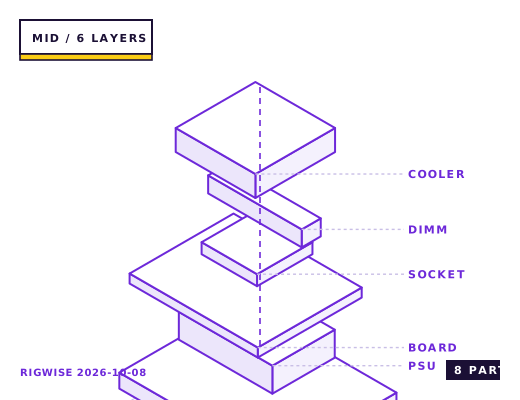
| Slot | Part | Interface | Draw | Price |
|---|---|---|---|---|
| CPU | AMD Ryzen 7 7700X | AM5 | 105 W | $279 |
| Motherboard | Gigabyte B650 AORUS ELITE AX V2 | AM5 | — | $179 |
| Memory | G.Skill Flare X5 DDR5-6000 CL30 2x16GB | DIMM | — | $104 |
| GPU | ASUS TUF Gaming GeForce RTX 5070 12GB (302 mm) | PCIe 5.0 x16 | 250 W | $599 |
| Storage | Samsung 990 PRO 2TB NVMe | M.2 2280 | 7 W | $149 |
| Cooler | Arctic Liquid Freezer III 360 (front mount) | AM5 | — | $109 |
| PSU | Corsair RM750e 80+ Gold | ATX | — | $99 |
| Case | Lian Li Lancool 216 (410 mm GPU clearance without radiator) | ATX | — | $99 |
| Total | 362 W | $1617 | ||
Why these parts
Where the numbers come from
A 360 mm radiator is 397 mm long and 27-38 mm thick, and its fans add 25 mm. The front-mounted total is therefore 55-63 mm. GPU length is measured from the bracket to the far edge of the shroud, so a listed 340 mm card occupies 340 mm plus 20-30 mm of power cable bend radius.
The case's GPU figure — say 360 mm — is usually quoted with the front fans installed and no radiator. Subtract the radiator's thickness plus fans and you get the real limit: 360 - 63 = 297 mm.
Which layouts avoid the conflict
Top-mounting the radiator moves the conflict to the motherboard's VRM heatsink and the CPU 8-pin connectors instead of the GPU. A 360 on top needs about 55 mm of clearance above the board, and on many mid-towers the front-most 120 mm section collides with the 8-pin EPS header.
The third option is a side-mounted radiator, which is available on dual-chamber cases. That removes the conflict entirely, at the cost of a wider case footprint.
The three measurements to take yourself
Measure the internal distance from the front fan mount to the PCIe bracket: this is your true GPU limit. Then measure from the top panel down to the top of the CPU 8-pin header, which is your top-radiator limit. Finally, measure the distance from the CPU socket centre to the top panel for cooler height.
Do all three with the case empty and the side panel off, using a tape measure rather than the spec sheet. Case specifications are frequently off by 5-10 mm, and the error is always in the direction that makes your part not fit.
Bottleneck note
In a mid-tower, the front radiator and the graphics card are the two components competing for the same volume. Whichever is longer wins and the other has to move.
Cooling headroom
A 360 mm radiator dissipates 350-400 W with fans at 1,200 rpm and 250-300 W at 800 rpm. If you are choosing a radiator for a 120 W CPU, you are buying noise headroom, not thermal capacity — a dual-tower air cooler does the same job at 45 dBA less cost.
Verdict
Measure the case yourself, subtract the radiator stack, and compare against the card plus cable bend. The spec sheet is a starting point, not an answer.
Tick each check once you have verified it. Ticks are stored in this browser only.
Why each check matters
The Lancool 216 lists 410 mm of GPU clearance — will a 302 mm card fit with a front 360?
Yes with 45 mm to spare: 410 - 63 (radiator plus fans) = 347 mm of usable GPU length. The card needs 302 mm plus about 25 mm of cable bend, totalling 327 mm, so it fits.
Can I top-mount the 360 instead and keep the front free?
On the Lancool 216, no — the top mount is 360-capable but the front-most fan section sits directly over the CPU 8-pin headers on most AM5 boards. Move the radiator to the front or use a 240 on top.
The Arctic radiator is 38 mm thick — does that change the calculation?
Yes. A standard 27 mm radiator plus fans is 52 mm; the Arctic's 38 mm plus fans is 63 mm. That 11 mm comes directly off your GPU clearance, so redo the subtraction with the actual thickness of the radiator you bought.
How much room do the GPU power cables really need?
25 mm minimum for a straight 8-pin, 35 mm for a 12V-2x6. Cables bent tighter than that put lateral load on the connector and are a documented cause of 12VHPWR failures. A 90-degree adapter removes the requirement.
Can I mount the radiator at the bottom as intake?
You can, but do not: mounting a radiator with the pump below the top of the radiator traps air in the pump, which is noisy and shortens pump life. Top or front mount only.
Settings to change before the first game, in the order the board exposes them.
BIOS
No BIOS setting changes clearance, but do set the pump header to 100% PWM and control the radiator fans from the CPU fan header. Pump speed does not affect noise much and running it from a temperature curve causes it to cycle, which is audible.
- Where the numbers come from
A 360 mm radiator is 397 mm long and 27-38 mm thick, and its fans add 25 mm. The front-mounted total is therefore 55-63 mm. GPU length is measured from the bracket to the far edge of the shroud, so a listed 340 mm card occupies 340 mm plus 20-30 mm of power cable bend radius.
- Which layouts avoid the conflict
Top-mounting the radiator moves the conflict to the motherboard's VRM heatsink and the CPU 8-pin connectors instead of the GPU. A 360 on top needs about 55 mm of clearance above the board, and on many mid-towers the front-most 120 mm section collides with the 8-pin EPS header.
- The three measurements to take yourself
Measure the internal distance from the front fan mount to the PCIe bracket: this is your true GPU limit. Then measure from the top panel down to the top of the CPU 8-pin header, which is your top-radiator limit. Finally, measure the distance from the CPU socket centre to the top panel for cooler height.
What to change first when this machine stops being enough.
- If the radiator does not fit in front, a 280 mm unit is 320 mm long and usually fits where a 360 does not, with about 8% less dissipation capacity.
- If the graphics card does not fit, look for a two-fan version of the same GPU — usually 40-60 mm shorter for a 3-5% performance cost.
- A 90-degree PCIe power adapter buys back 20-25 mm of cable bend radius in a tight front-radiator layout.
Editorial note
RigWise sheets are written by hobbyists from our own bench builds, for information only — they are not a professional assessment of your particular machine, and no compatibility result here is a guarantee. Where a step involves mains wiring or a part you have not handled before, get a qualified second opinion before you buy or power on.