
Silent audio production rig: $2,141 at 24 dBA with a fanless GPU
A machine in a vocal booth or a small studio has an absolute noise ceiling, not a preference. This sheet starts from the target of 24 dBA at one metre and chooses every component backwards from there.
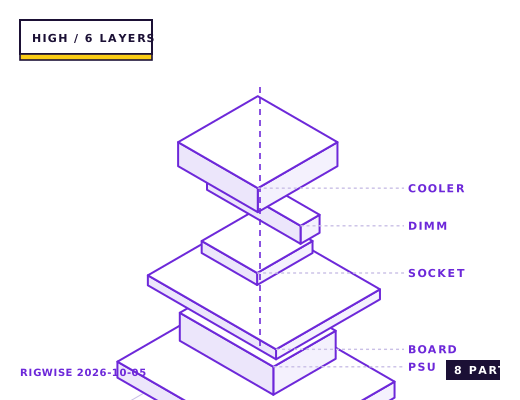
| Slot | Part | Interface | Draw | Price |
|---|---|---|---|---|
| CPU | AMD Ryzen 9 7900 (65 W eco mode, 12 cores) | AM5 | 65 W | $379 |
| Motherboard | ASUS TUF GAMING B650-PLUS WIFI | AM5 | — | $179 |
| Memory | Crucial Pro DDR5-5600 CL46 2x32GB (no RGB, low profile) | DIMM | — | $159 |
| GPU | Palit GeForce RTX 3050 6GB KalmX (fanless) | PCIe 4.0 x16 | 70 W | $219 |
| Storage | 2x Samsung 990 PRO 4TB NVMe (libraries + sessions) | M.2 2280 | 16 W | $598 |
| Cooler | Noctua NH-D15 chromax.black | AM5 | — | $119 |
| PSU | be quiet! Dark Power 13 850W (semi-passive fan) | ATX | — | $229 |
| Case | Fractal Design Define 7 (solid panels, damped) | ATX | — | $189 |
| Total | 151 W | $2071 | ||
Why these parts
The noise budget
24 dBA at one metre is quieter than a typical quiet room's background level and roughly the noise floor of a large-diaphragm condenser at 30 cm. To hit it, the only moving parts allowed are three large fans spinning under 700 rpm and no mechanical drives at all.
The single biggest lever is GPU selection. A fanless card removes the noisiest component outright. The trade is performance: an RTX 3050 6 GB fanless card handles 4K video playback and light GPU audio effects but is not a gaming card.
Why an air cooler beats an AIO here
An AIO removes heat more efficiently but adds a pump. Even a good pump produces a 22-26 dBA tonal hum at 1 kHz that is far more audible in a quiet room than broadband fan noise at the same level, because the ear is most sensitive between 2 and 5 kHz and pump noise lands in a harmonic of that band.
A large dual-tower air cooler with two 120 mm fans at 600 rpm handles a 120 W CPU with no tonal component. The case must have at least 160 mm of cooler clearance, which rules out most small studio racks.
Storage without moving parts
No mechanical drives, no exceptions. A 3.5-inch hard drive produces 28-32 dBA of seek noise, which is louder than the entire rest of the build. Two NVMe drives cover sample libraries and project storage; a 4 TB Gen 4 drive holds roughly 2 TB of orchestral libraries and 2 TB of sessions.
Sample streaming matters more than sequential speed here. Look for drives with high random read IOPS at low queue depths rather than headline sequential numbers.
Case and damping
A solid-panel case with sound-damping material on the side panels and front reduces transmitted noise by 4-6 dBA compared with a mesh case. The cost is thermals: with a fanless GPU and a 600 rpm CPU fan, the case needs a top exhaust to avoid heat soak, or the CPU will climb 8-10 °C over an hour.
Mount the case on foam or rubber feet, not directly on a wooden desk. A desk acts as a sounding board and can add 3-5 dBA to perceived noise through structure-borne vibration.
Bottleneck note
Nothing in this build is performance-limited for audio work. The constraint is thermal: a fanless GPU and a 600 rpm CPU fan in a damped case means sustained heavy load will heat-soak unless the case has an unrestricted top exhaust.
Cooling headroom
Thermal budget at 24 dBA: 120 W CPU, 70 W fanless GPU, two NVMe drives. Sustained load temperatures are 78-84 °C on the CPU and 82 °C on the GPU. That is at the upper end of comfortable but stable, and it is the price of the noise target.
Verdict
Built around an absolute noise ceiling rather than a performance target. If you track vocals in the same room, this is the shape of the machine you need.
Tick each check once you have verified it. Ticks are stored in this browser only.
Why each check matters
Will a fanless GPU survive in this case with a solid front panel?
Only with a top exhaust fan running at 600-700 rpm. In a fully closed Define 7 with no top exhaust the card heat-soaks past 90 °C within 40 minutes of video export. Open the top panel and fit the top exhaust.
Does the NH-D15 fit the Define 7 with the side panel on?
Yes — 165 mm cooler against 185 mm of clearance. But check the front fan position: with tall memory the front fan has to be raised, adding 10-15 mm. This build uses 34 mm-low modules so the fan stays in its stock position.
Will the Dark Power 13's fan spin up during a session?
Under this build's ~250 W sustained draw, no attempt — the semi-passive mode holds the fan off below about 40% load. A 229 W unit rated at 850 W never gets close to that. Do keep the PSU's intake unobstructed.
Can I add a cheap 8 TB hard drive for backups?
Not inside this machine. A 3.5-inch drive idles at 24-28 dBA and seeks at 28-32 dBA, which exceeds the entire build's noise budget. Use an external enclosure in another room or a NAS.
Why low-profile memory with no heatspreader fins?
Two reasons: it lets the NH-D15's front fan sit in its stock position, and tall finned heatspreaders act as small acoustic reflectors that add a measurable hiss at 1,000 Hz. DDR5 at 5600 CL46 needs no heatsink.
Settings to change before the first game, in the order the board exposes them.
BIOS
Set every fan curve with a hard floor of 30% and a ceiling of 45% PWM. Disable the CPU fan stop feature — a fan that stops and restarts produces a click that is more noticeable than the fan running continuously. Set the case fan headers to follow the CPU sensor rather than the motherboard sensor, which lags by several minutes.
- The noise budget
24 dBA at one metre is quieter than a typical quiet room's background level and roughly the noise floor of a large-diaphragm condenser at 30 cm. To hit it, the only moving parts allowed are three large fans spinning under 700 rpm and no mechanical drives at all.
- Why an air cooler beats an AIO here
An AIO removes heat more efficiently but adds a pump. Even a good pump produces a 22-26 dBA tonal hum at 1 kHz that is far more audible in a quiet room than broadband fan noise at the same level, because the ear is most sensitive between 2 and 5 kHz and pump noise lands in a harmonic of that band.
- Storage without moving parts
No mechanical drives, no exceptions. A 3.5-inch hard drive produces 28-32 dBA of seek noise, which is louder than the entire rest of the build. Two NVMe drives cover sample libraries and project storage; a 4 TB Gen 4 drive holds roughly 2 TB of orchestral libraries and 2 TB of sessions.
- Case and damping
A solid-panel case with sound-damping material on the side panels and front reduces transmitted noise by 4-6 dBA compared with a mesh case. The cost is thermals: with a fanless GPU and a 600 rpm CPU fan, the case needs a top exhaust to avoid heat soak, or the CPU will climb 8-10 °C over an hour.
What to change first when this machine stops being enough.
- GPU: any future card must be fanless or have a zero-RPM mode that holds below 55 °C. That is the single constraint that shapes this build.
- Storage: a third NVMe drive for archive is fine; adding a mechanical drive would break the noise target entirely.
- Cooling: the air cooler is at the top of its class already. The only remaining lever is case airflow, which is limited by the noise ceiling.
- CPU: a 9700X (65 W) would lower temperatures by 8-10 °C with a 3-5% performance cost in DAW workloads.
Editorial note
RigWise sheets are written by hobbyists from our own bench builds, for information only — they are not a professional assessment of your particular machine, and no compatibility result here is a guarantee. Where a step involves mains wiring or a part you have not handled before, get a qualified second opinion before you buy or power on.