
How much PSU wattage you actually need: the transient-spike maths
Adding up TDP figures gives you a number that is too low, because modern graphics cards draw two to three times their rated power for microseconds at a time. Here is the calculation that accounts for it.
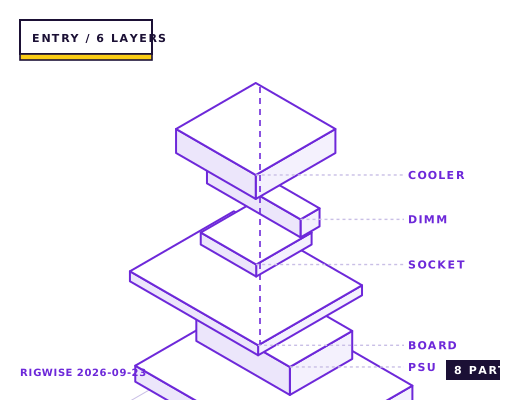
| Slot | Part | Interface | Draw | Price |
|---|---|---|---|---|
| CPU | AMD Ryzen 7 7800X3D | AM5 | 120 W | $349 |
| Motherboard | Gigabyte B650 AORUS ELITE AX V2 | AM5 | — | $179 |
| Memory | G.Skill Flare X5 DDR5-6000 CL30 2x16GB | DIMM | — | $104 |
| GPU | Sapphire PULSE Radeon RX 9070 16GB | PCIe 5.0 x16 | 220 W | $549 |
| Storage | Crucial P3 Plus 2TB NVMe | M.2 2280 | 5 W | $99 |
| Cooler | Thermalright Peerless Assassin 120 SE | AM5 | — | $36 |
| PSU | MSI MPG A650GF 80+ Gold (sized by the formula above) | ATX | — | $89 |
| Case | Corsair 4000D Airflow | ATX | — | $89 |
| Total | 345 W | $1494 | ||
Why these parts
The three numbers that matter
Sustained draw: CPU package power under all-core load plus GPU board power plus 30-40 W for the board, drives, fans and USB. For a 7800X3D (120 W) and an RX 9070 (220 W) that is about 380 W.
Transient peak: a modern GPU can pull 2-2.5x its board power for 1-10 ms. An RX 9070 that averages 220 W can spike to 480-550 W. The PSU must absorb this without tripping over-current protection.
Capacitor ageing: an electrolytic PSU loses roughly 10-15% of its usable capacity over eight years of daily use at 40 °C ambient. If you plan to keep the unit for two builds, size for the future load, not today's.
The formula in practice
Take the sustained draw, add 100 W of headroom for transients on a single-GPU system, and round up to the nearest standard size. 380 W + 100 W = 480 W, so a 550 W unit is the floor and a 650 W unit is the comfortable choice.
For a 5080 build (360 W) with a 9800X3D (120 W) the sustained draw is 520 W and the transient margin is 200 W, so 750 W is the floor and 850 W is comfortable. This is why nearly every high-end build lands on 850 W.
Why efficiency rating matters less than you think
The difference between Gold and Platinum at 50% load is about 2.5 percentage points, which on a 400 W draw is 10 W at the wall — roughly $3 a year at average US electricity prices. What you are actually paying for with a higher rating is usually better build quality, a longer warranty, and better transient response.
Transient response is the spec that matters and is never printed on the box. Look for reviews that measure 12 V rail droop under a 1 ms load step; a good unit holds within 1% and a poor one sags 3-4% and triggers a shutdown.
Single-rail, multi-rail and the 12V-2x6 connector
Multi-rail PSUs split the 12 V output across several current-limited rails. On a card with high transients this can cause spurious shutdowns if the card is fed from one rail. Check the manual's rail assignment table and split the GPU's cables across rails if your unit is multi-rail.
The 12V-2x6 connector is rated for 600 W but the sense pins only work correctly if the connector is fully seated. The most common failure mode is not a defective cable; it is a cable inserted at an angle that looks seated but is not. Push until it clicks, then check the gap on both sides.
Bottleneck note
Oversizing the PSU does not improve performance. Undersizing it causes random shutdowns under load that are hard to diagnose and often blamed on the GPU or the motherboard.
Cooling headroom
A PSU's fan curve is set by its own internal temperature sensor, not the case. In a bottom-mounted intake configuration with a dust filter, clean the filter every three months — a clogged filter is the usual cause of a PSU fan running at full speed in an otherwise quiet machine.
Verdict
Add the sustained draw, add 100-200 W for transients, round up. That number, plus a review that measures transient response, is the whole decision.
Same tier, other sheets
- 1080p esports starter: a $788 AM5 rig that holds 200 fps in Valorant and CS2
- Is an ex-office AM4 tower worth upgrading? A part-by-part compatibility answer
- Living-room SFF: a 12.4 L build with a 7500F and low-profile RTX 4060 for $1,043
- New build will not post: the 12-point check in the order that finds it fastest
Tick each check once you have verified it. Ticks are stored in this browser only.
Why each check matters
Can I power a 300 W card with one daisy-chained PCIe cable?
No. A single 8-pin cable with a pigtail is rated for 150 W at the connector plus 75 W from the slot. A 300 W card needs two separate cables from the PSU, even though one cable physically fits.
The machine shuts down only in one specific game — is the PSU at fault?
Possibly. A hard power-off (not a crash or a reboot) under a specific load is the classic signature of OCP tripping on a transient spike. Test by capping the GPU's power limit to 80% in software; if the shutdown stops, the PSU is the cause.
How do I know the 12V-2x6 connector is fully seated?
There should be no visible gap between the plug and the socket on either side, and the latch must click. Check with the machine off and the cable not under tension. A partially seated connector is the documented cause of the melting failures.
Does the PSU fan face up or down in a bottom-mounted case?
Fan down if the case has a filtered floor intake — that draws cool air from outside. Fan up only if the case sits on carpet, where the floor intake is blocked.
Do I need both CPU 8-pin connectors plugged in?
For a 65-120 W CPU, one 8-pin EPS is enough — it supplies 235 W. The second connector only matters for overclocked 16-core parts. Leaving it unplugged is safe; leaving the primary one unplugged is not.
Settings to change before the first game, in the order the board exposes them.
BIOS
Nothing here is a BIOS setting, but do disable any motherboard 'power saving' mode that parks PCIe lanes when idle. Aggressive ASPM on some boards causes the GPU to drop a link width on wake and produces a black screen for two seconds.
- The three numbers that matter
Sustained draw: CPU package power under all-core load plus GPU board power plus 30-40 W for the board, drives, fans and USB. For a 7800X3D (120 W) and an RX 9070 (220 W) that is about 380 W.
- The formula in practice
Take the sustained draw, add 100 W of headroom for transients on a single-GPU system, and round up to the nearest standard size. 380 W + 100 W = 480 W, so a 550 W unit is the floor and a 650 W unit is the comfortable choice.
- Why efficiency rating matters less than you think
The difference between Gold and Platinum at 50% load is about 2.5 percentage points, which on a 400 W draw is 10 W at the wall — roughly $3 a year at average US electricity prices. What you are actually paying for with a higher rating is usually better build quality, a longer warranty, and better transient response.
- Single-rail, multi-rail and the 12V-2x6 connector
Multi-rail PSUs split the 12 V output across several current-limited rails. On a card with high transients this can cause spurious shutdowns if the card is fed from one rail. Check the manual's rail assignment table and split the GPU's cables across rails if your unit is multi-rail.
What to change first when this machine stops being enough.
- Buy the wattage for the GPU you plan to have in two years, not the one you have now.
- Cable quality matters more than wattage once you are above 750 W: look for 16 AWG wires on the PCIe cables.
- If you move to a 5090-class card, 1000 W is the realistic floor, not 850 W.
Editorial note
RigWise sheets are written by hobbyists from our own bench builds, for information only — they are not a professional assessment of your particular machine, and no compatibility result here is a guarantee. Where a step involves mains wiring or a part you have not handled before, get a qualified second opinion before you buy or power on.